
The battle for the presidency of world football’s most powerful institution is quietly gathering momentum, and despite mounting criticism from sections of the global game, Gianni Infantino remains firmly on course to seek another four-year mandate as FIFA president.
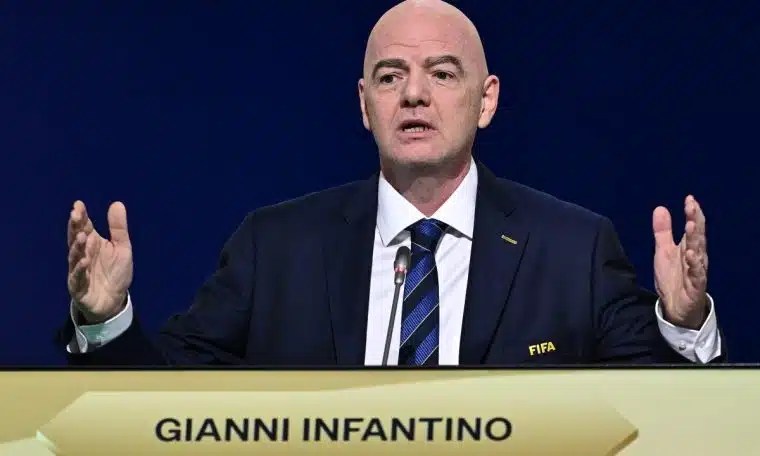
While his potential bid has reignited debate over FIFA’s term-limit rules and governance, the Swiss-Italian football administrator still commands formidable political support across much of the football world, setting the stage for what could become one of the most closely watched elections in FIFA history.
Can Infantino Legally Run Again?
At the heart of the controversy is a question that continues to divide football administrators: Has Gianni Infantino already exhausted the maximum number of terms permitted under FIFA statutes?
FIFA’s constitution limits its president to three four-year terms.
On paper, that appears to rule Infantino out of the March 2027 election.
However, the FIFA chief has consistently maintained that his first stint in office, which began in 2016 following the suspension and eventual exit of Sepp Blatter, lasted only three years and therefore should not be counted as a full presidential term.
That interpretation was accepted by FIFA, allowing him to contest and win re-election unopposed in both 2019 and 2023.
Unless that position is successfully challenged, Infantino is expected to seek yet another mandate.
FIFA’s Biggest Critics Search For A Challenger
While Infantino remains the favourite, attention has shifted to whether his critics—particularly within UEFA—can unite behind a credible opponent capable of threatening his dominance.
Any challenger hoping to enter the race must first secure nominations before November 18, 2026, including at least five letters of support from FIFA member associations.
The presidential election itself will take place during the 77th FIFA Congress, scheduled for March 18, 2027, in Rabat, Morocco.
How The FIFA Election Works
The voting process is designed to produce a clear winner but becomes increasingly demanding when multiple candidates are involved.
If only two candidates contest the presidency, victory requires nothing more than a simple majority of votes from FIFA’s 211 member associations.
However, if three or more candidates enter the race, the rules become far more complex.
A candidate must initially secure 75 percent of the votes to win outright.
If no one reaches that threshold, the candidate with the fewest votes is eliminated before another round is held.
The process continues until only two candidates remain, after which a simple majority decides the winner.
Why Infantino Still Holds The Advantage
Despite facing growing scrutiny in Europe, many observers believe Infantino remains the overwhelming favourite.
One of the pillars of his political success has been his relentless engagement with football associations around the world.
Since first campaigning for the FIFA presidency in 2016, Infantino has prioritised extensive international travel, regularly visiting national football federations and strengthening personal relationships with football leaders.
During his original campaign, he disclosed that UEFA provided him with a campaign budget of €500,000, largely to finance international travel as he sought support across FIFA’s global membership.
Nearly a decade later, that strategy remains central to his leadership.
Fresh from attending a FIFA Management Board meeting in Rabat, Infantino immediately travelled to South America to attend the inauguration of Colombia’s new president, Abelardo de la Espriella, underscoring his continued global diplomatic outreach.
The Money That Could Decide The Election
Beyond diplomacy, FIFA’s financial programmes remain one of Infantino’s strongest political assets.
Through the FIFA Forward Programme, football associations around the world receive millions of dollars to develop infrastructure, grassroots football and administrative capacity.
For many smaller nations that lack substantial domestic funding, the programme has become indispensable.
Under the current FIFA Forward 3.0 cycle, each member association has received funding of up to $8 million over four years—a 30 percent increase compared to the previous funding model.
With Forward 4.0 expected to deliver even higher financial support, many analysts believe Infantino’s backing among developing football nations could grow even stronger ahead of the election.
Europe Leads The Resistance
Support for Infantino remains deeply divided across FIFA’s six continental confederations.
UEFA, representing 55 member associations, has emerged as his strongest and most vocal critic, particularly following recent controversies surrounding FIFA’s proposed Football Enterprise initiative.
However, there is increasing speculation that Europe’s opposition may not remain completely united when voting eventually begins.
Africa Stands Firm Behind FIFA Boss
In contrast, Africa’s 54 football associations have publicly reaffirmed unanimous support for Infantino.
That endorsement alone represents one of the largest voting blocs available to any presidential candidate and significantly strengthens his re-election prospects.
Asia And CONCACAF Still Undecided
Asia presents a more complicated picture.
Although the Asian Football Confederation (AFC) criticised aspects of the controversial FIFA Football Enterprise proposal, it stopped short of directly opposing Infantino after the project was shelved.
So far, Jordan remains the only Asian member association to publicly declare it will not support his re-election.
Meanwhile, CONCACAF, representing 35 member associations, has also voiced criticism of Infantino in recent months.
Yet cracks within the confederation are already beginning to emerge.
Mexico has openly backed Infantino’s bid, while many smaller Caribbean and Central American football nations—major beneficiaries of FIFA funding—could ultimately vote in his favour.
Oceania And South America Hold The Keys
The Oceania Football Confederation (OFC) has yet to reveal its official position and is expected to do so after a meeting scheduled for September.
Earlier this year, OFC president Lambert Maltock praised Infantino’s leadership and hailed his investment in grassroots football, remarks widely interpreted as a positive signal.
In South America, the tone has been more cautious than confrontational.
Although CONMEBOL warned that future governance controversies could influence its support, several influential member nations—including Argentina and Paraguay—have already publicly endorsed Infantino’s bid for another term.
A Presidency Still Built On Numbers
With overwhelming backing across Africa, significant support in Asia, Oceania and South America, and billions of dollars flowing through FIFA development programmes, Gianni Infantino enters the race with considerable political momentum.
But growing resistance from Europe and fresh questions over FIFA’s governance mean the road to another term may not be as straightforward as his previous uncontested victories.
As nominations approach, the biggest question is no longer whether Infantino wants another four years—but whether world football can produce a challenger capable of stopping him.