
For nearly a century, the three-storey building on Flatbush Avenue stood as one more piece of Brooklyn’s stubborn old fabric — brick, mortar and memory, built in 1930 and still holding its place on a street that has seen generations come and go. On Wednesday afternoon, in the space of a few seconds, one entire side of it simply ceased to exist.
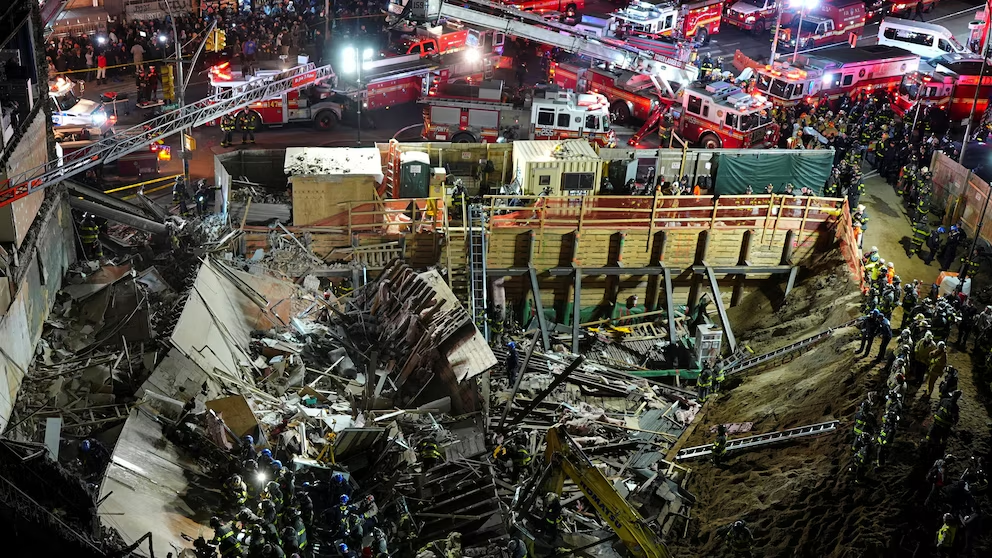
The collapse happened at about 4pm local time, 9pm GMT, and it did not happen quietly. The structure gave way into an open construction site beside it, sending concrete, metal and the intimate contents of people’s homes cascading into a pit of debris. Bedrooms and closets that had no business being visible to the street were suddenly exposed to the sky, their contents — clothes, furniture, the ordinary evidence of lives being lived — scattered among the wreckage.
And then came the question that always follows a sound like that: was anyone still inside?
The Response
Within moments, New York City’s emergency apparatus lurched into motion. More than 250 first responders converged on the scene, and the New York City Fire Department launched what its commissioner, Lillian Bonsignore, described as an “extremely dangerous” search-and-rescue operation.
She said people from both the collapsed building and the adjacent construction site had been trapped.
“Members have been working methodically and haven’t stopped since they arrived this afternoon,” Bonsignore said.
The numbers that emerged were grim: at least two people dead, more than 17 injured. But amid those figures came a moment that stopped the afternoon cold. Hours into the operation, aerial footage captured firefighters pulling a survivor from the debris — covered in dust, strapped to a stretcher, alive.
The Mayor at the Scene
New York City Mayor Zohran Mamdani arrived at the scene and stood with the responders, praising the speed of their deployment.
They “arrived in under a minute and have spent hours working in dangerous and highly technical conditions to rescue New Yorkers,” he wrote later on X.
That detail — under a minute — is the kind of thing that sounds like a statistic until you remember what it means. It means someone was already moving before the dust had settled. It means the difference between a rescue and a recovery was measured in seconds.
What We Still Do Not Know
Authorities have not yet determined what caused the collapse. The building, city records show, dates back to 1930 — a structure old enough to have outlived most of the people who built it, and old enough that its failure raises questions no one can yet answer.
You May Like: The Impeachment That Wasn’t: Inside the Failed Bid to Remove Pete Hegseth
Was it the construction next door? The age of the structure? Something that had been visible for years and ignored? Those questions will be asked in the coming days, and the answers may not be comfortable.
The Night Ahead
As Wednesday turned to Thursday, the operation continued. Crews worked under floodlights, sifting through concrete and twisted metal, looking for anyone still breathing beneath the weight of a building that had stood for almost a hundred years and then, in an afternoon, was gone.
For the families waiting nearby, the vigil is not over. For the city, the reckoning has not yet begun.